|
Cave Life of Wales |
 |

| |
| HOME |
| INTRODUCTION |
| LIFE IN THE ENTRANCE |
| LIFE IN THE CAVE |
| CONSERVATION |
| GLOSSARY |
| ACKNOWLEDGEMENTS |
| |
| Bacteria |
| Fungi |
| Plants, Algae & Protozoans |
| Sponges |
| Flatworms |
| Eelworms & Segmented Worms |
| Slugs & Snails |
| Crustacea |
| Insects |
| Spiders & Millipedes |
| Fish & Amphibians |
| Birds |
| Bats |
Life in the cave - Slugs & Snails |
||||
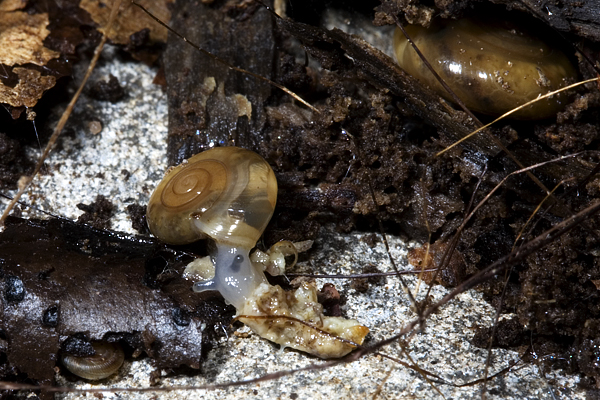
Slugs and snails are examples of Molluscs. Most of the living molluscs in caves are gastropods and many are omnivores – like man they feed on a variety of food types. Snails
Slugs are seen in Porth yr Ogof but I am not sure if any have been identified. The following is a list of snails from Ogof Draenen: Cellar Snail Oxychilus cellarius, Point Snail Acicula fusca, Herald Snail Carychium minimum, Common Door Snail Clausilia bidentata, Rounded Snail Discus rotundatus, Lesser Bulin Ena obscura, Crystal Snail Vitrea contracta, Hairy Snail Trichia hispida, Furrowed or Strawberry Snail Trichia striolata. In caves near the sea the Rough (Littorina saxatilis) and Small Periwinkle (Melaraphe neritoides) can be found surviving above the high tide mark.
Fossils Inside the caves you will also see many fossils of another group of Molluscs - the Brachiopods (means 'arm foot', commonly known as lampshells). These creatures had two unequal parts to their shell but are unrelated to the present day similar creatures in the Mollusc phylum e.g. clams. They used to be very common but have been declining for the last 100 million years and will probably eventually become extinct. In the cave these fossils appear as circles and semicircles of white.
|